private aviation
Private Jet vs. First Class: When Does Private Actually Win?
Private jets usually beat first class at four or more passengers, or on short regional routes. Below that, commercial often wins. Here's the honest math.
Private Jet vs. First Class: When Does Private Actually Win?
By David Young · September 1, 2026
Quick Summary
- A private jet charter costs roughly $3,500–$13,000 per flight hour for the whole aircraft. A first class ticket runs roughly $500–$2,000 domestic and $3,000–$15,000 international, per person.
- The break-even is usually four to six passengers. Below four on a route with good commercial service, first class almost always wins on cost.
- Private wins hardest on time and access, not price: 5,000+ U.S. airports versus about 500 served by the airlines, and a typical 90 to 180 minutes saved door-to-door.
- The honest answer for most solo business trips is: fly commercial. We’ll tell you that.
Most articles comparing private jets to first class are written by people who only make money if you pick the jet. This one isn’t. We’re aviation advisors, we broker charter, and we also tell clients to book Delta when that’s the smarter call.
Here’s how the math actually works, where the break-even sits, and how to tell which side of it your trip falls on.
How much does a private jet cost compared to first class?
The two are priced on completely different logic, which is where most comparisons go wrong.
What you’re buying with a commercial ticket
A first class fare is priced per seat, per person. On a domestic route, that’s often $500 to $2,000 one-way. On a long-haul international route, first class commonly lands between $3,000 and $15,000 per person depending on carrier, cabin, and how far out you book.
That price includes the crew, the fuel, the taxes, and the airline’s schedule. You don’t control any of it.
What you’re buying with a charter
A charter is priced per aircraft, per flight hour. As of 2026, typical market rates look roughly like this:
- Turboprops: $2,300–$3,500/hr
- Light jets: $3,500–$5,500/hr
- Midsize and super-midsize: $5,500–$8,000/hr
- Heavy jets: $9,500–$13,000/hr
- Ultra-long-range and VIP airliners: $13,000–$23,000/hr
That hourly rate is not your invoice. Fuel surcharges, the 7.5% federal excise tax, segment fees, landing and FBO charges, catering, and crew overnights typically add 25% to 40% on top of the headline number. Any quote that doesn’t show you those lines is hiding them. If you’ve already received a charter quote and want it pressure-tested line by line, send it to us and an advisor will walk you through it.
At how many passengers is a private jet cheaper than first class?
This is the question that actually decides it. Here’s a realistic side-by-side on three common trips.
| Trip | Aircraft / Cabin | Est. all-in private cost | First class per person | Private break-even |
|---|---|---|---|---|
| Los Angeles → Aspen (2.0 hr) | Light jet | $11,000–$15,000 | ~$900 (with a connection) | ~9–12 passengers |
| New York → Miami (2.75 hr) | Midsize jet | $22,000–$30,000 | ~$1,400 | ~14–18 passengers |
| New York → London (7.0 hr) | Heavy jet | $95,000–$120,000 | ~$9,500 | ~10–12 passengers |
| Nashville → Ft. Lauderdale, 8 people (2.0 hr) | Super-midsize | $24,000–$30,000 | ~$1,100 each ($8,800 total) | Already close |
Read that table honestly and the pattern is clear: on pure ticket price, private rarely “wins.” The break-even on most routes sits well above the number of people actually traveling.
Where it flips is when the trip has structure a commercial schedule can’t hold, a full team, a same-day return, three cities in two days, or an airport the airlines don’t serve. That’s when the per-person number stops being the right measure. For teams and touring parties, we break the economics down further in our group charter guide.
Does flying private actually save time?
Yes, and this is the strongest honest argument for it.
Private aircraft can use more than 5,000 public airports in the U.S. Commercial airlines serve roughly 500. In Europe the ratio is similar, about 3,000 usable fields versus roughly 300 with scheduled service.
The practical effect: you fly to the airport nearest your actual destination, not the nearest hub. You arrive 15 minutes before departure instead of two hours. You skip the security line, the connection, and the bag carousel.
Across typical business routes, that adds up to 90 to 180 minutes saved door-to-door. The European Business Aviation Association has measured the average at about 127 minutes per flight. Savings are largest on short regional sectors, where airport procedures eat a disproportionate share of total journey time, a 55-minute flight with three hours of airport overhead is where private aviation looks best.
The part nobody prices
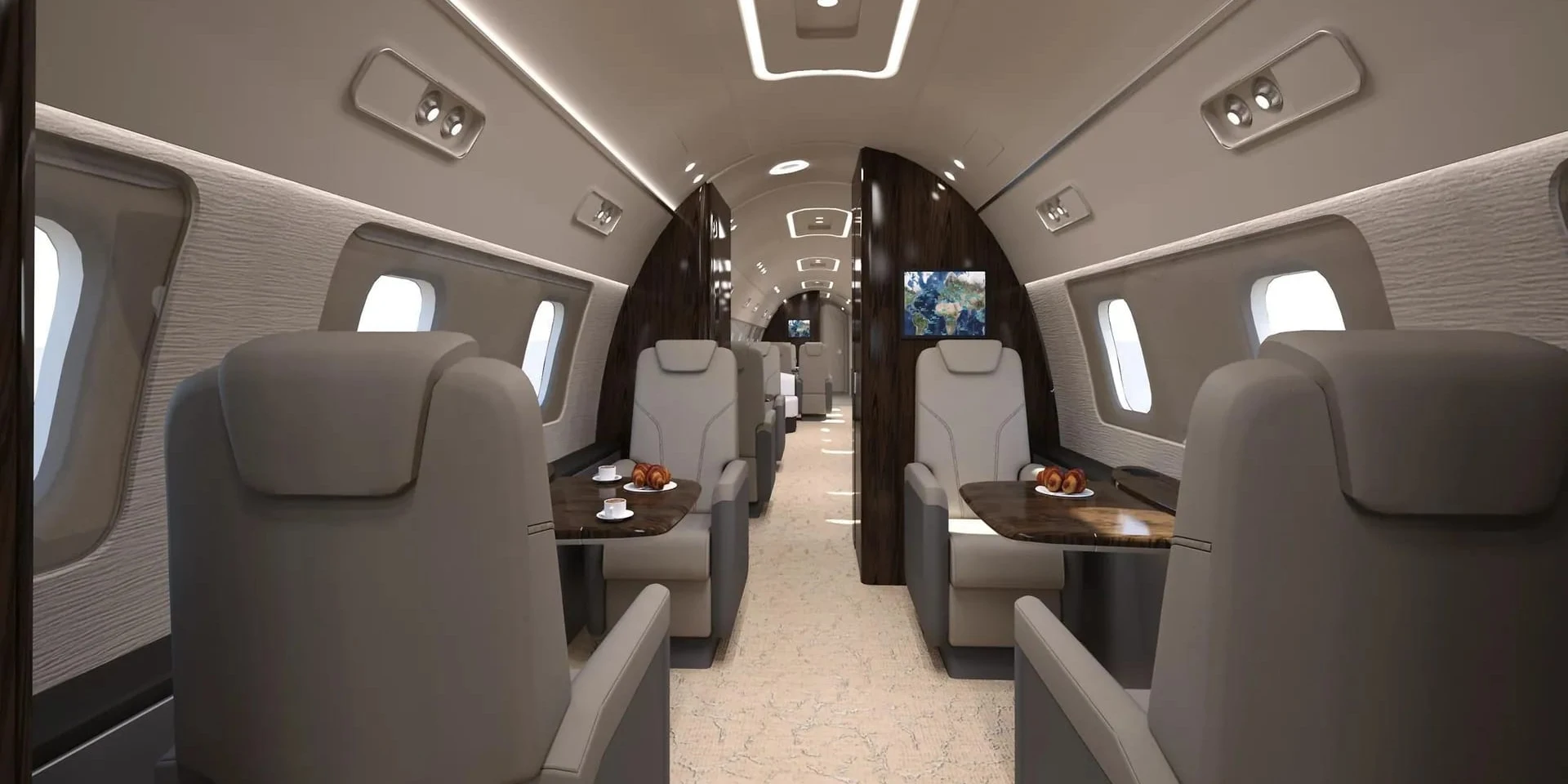
There’s also the cabin itself. You can hold a confidential call, run a deal review, or discuss a roster with your own people and no one else. For some clients that’s a convenience. For principals in a live transaction, it’s the actual reason they charter.
When does first class still win?
We’d rather say this plainly than have you find out after you’ve paid.
Book commercial when:
- You’re traveling solo or as a pair on a well-served nonstop route.
- Your schedule is flexible and a 7 a.m. departure costs you nothing.
- The route is long-haul with strong lie-flat service, a good business class seat on an 11-hour flight is genuinely competitive with a mid-cabin charter, at a tenth of the cost.
- Price is the deciding factor. If cost is the top constraint, commercial wins and no amount of framing changes that.
Charter when:
- You’re moving four or more people who need to arrive together.
- Your destination has poor or no commercial service, Aspen, Sun Valley, Teterboro, Van Nuys, most of the mountain west.
- The trip is same-day return or multi-city, where commercial schedules would cost you an extra night.
- Timing is the asset: a closing, a game, a show call, a board meeting that can’t slip.
Our True Demand charter is built for exactly these one-off trips: any aircraft type, one advisor owning the request start to finish, and TS Trip Protection so a mechanical on your tail doesn’t become your problem to solve at 6 a.m.
What about international and long-haul flights?
Long-haul is where the comparison gets most interesting, because the commercial product is genuinely good.
A modern business class suite gives you a flat bed, real food, and a 12-hour block of sleep for a few thousand dollars. A heavy jet crossing the Atlantic runs $95,000 to $120,000 all-in. For one or two travelers, that is not a close call.
But at eight to ten passengers, per-person charter cost on a long-haul route lands in the same neighborhood as individual first class fares, and you get direct routing, no connection through a hub, and the ability to depart when your meetings end rather than when the schedule says.
Two things to watch on international charters: crew duty limits may require a second crew or a tech stop on ultra-long sectors, and customs and immigration arrangements vary by airport. Both affect price and timing. A good advisor raises them before you book, not after.
How should you decide for your own trip?
Run three questions, in this order.
- How many people are actually flying? Under four, start with commercial and prove private is necessary. Four or more, price both.
- What does the schedule cost you? Put a number on the lost day, the extra hotel night, the missed meeting. If that number is larger than the price gap, charter is rational.
- Can commercial even do it? If your destination has no service or the only routing has two connections, the comparison is already over.
If you fly enough that you’re running this calculation monthly, the structure changes the answer. Our Reserve program uses refundable deposits and wholesale operator pricing with a fixed service fee that gets smaller the more you fly, and it’s the only place we separate operator cost from our fee on the invoice. There are no blackout dates. If you’re flying enough to consider owning a share, our fractional advisory work starts with whether you should, not which program to buy.
Frequently asked questions
Is flying private worth it? For four or more passengers, for poorly served destinations, or when your schedule has real financial value, usually yes. For a solo traveler on a well-served nonstop route with flexible timing, usually no. The honest answer depends on the trip, not on your net worth.
How much does a private jet cost compared to first class? A charter costs $3,500 to $13,000 per hour for the whole aircraft, all-in cost typically 25–40% above that headline rate. First class costs $500 to $2,000 per person domestically and $3,000 to $15,000 internationally. Divide the charter total by your passenger count to compare fairly.
At how many passengers does a private jet become cheaper than first class? Typically four to six on high-fare routes, and eight to ten on long-haul international. On short domestic routes with cheap first class fares, the break-even can be twelve or more, meaning private rarely wins on cost alone there.
Is private jet or business class better for international flights? For one to three travelers, business class is the better value on almost any long-haul route, the lie-flat product is genuinely excellent. Private makes sense internationally when you’re moving a group, need a specific departure time, or want to avoid connecting through a hub.
How much time does a private jet actually save? Typically 90 to 180 minutes door-to-door, averaging about 127 minutes per flight. The savings come from airport access, no security lines, no connections, and a 15-minute arrival window. Short regional flights see the biggest gains.
The comparison isn’t really “private jet versus first class.” It’s whether the specific trip in front of you has enough people, enough schedule pressure, or enough airport difficulty to justify buying the whole aircraft. Sometimes it does. Often it doesn’t. Either way, you should get a straight answer before you get a quote.
Every flight we source comes from a vetted Part 135 or Part 121 carrier, assessed with ARG/US, Wyvern and IS-BAO data, and every crew passes an ARG/US TripCHEQ. No gimmicks, no overpromising, just smart options and real people.