
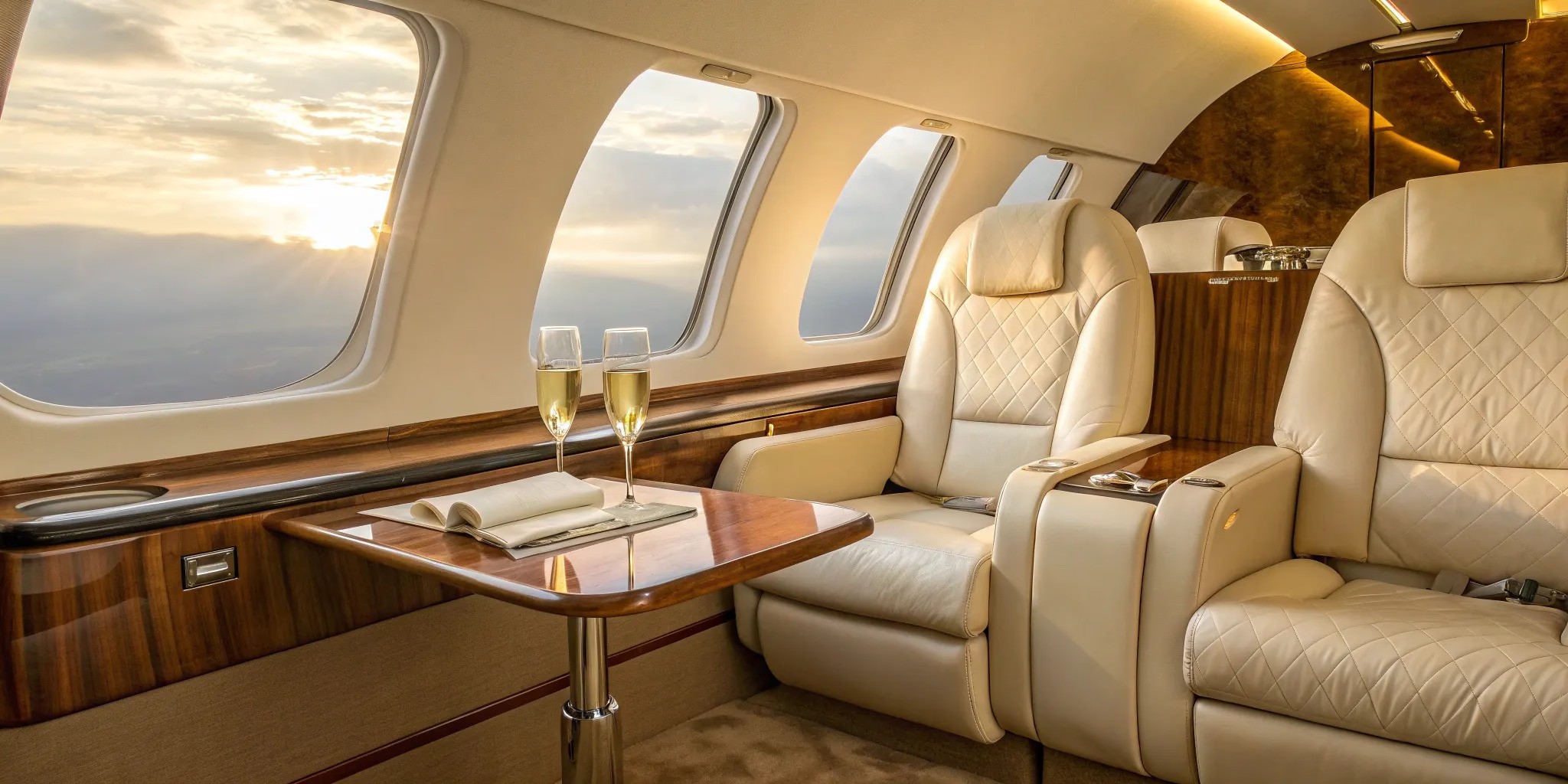
Private Jet from New York to the Bahamas: A Complete Charter Guide
Everything you need to know about chartering a private jet from New York to the Bahamas — costs, aircraft, airports, and how to get the best value on this iconic Caribbean route.

The New York to Bahamas route is, without question, one of the most-requested private jet journeys in the Western Hemisphere, and for good reason.
What would take the better part of a day through commercial channels — the cab to JFK, the security queue, the connection, the wait, the lost afternoon — becomes a 2.5 to 3.5-hour nonstop flight from a private terminal, typically departing from Teterboro Airport (TEB) or Westchester County Airport (HPN). You leave New York. You arrive in Nassau, Harbour Island, or Exuma. No crowds, no connections, no compromises.
But booking this route well requires more than just picking a jet. The aircraft type, departure airport, operator selection, and timing all determine whether you pay $15,000 or $45,000 for the same journey. This guide breaks all of it down, so you can book with clarity and confidence.
Key Takeaways
Flight time is short, but aircraft selection matters: The New York to Bahamas route typically takes 2.5–3.5 hours depending on your destination island and aircraft — making midsize and super-midsize jets the sweet spot for most travellers.
Cost ranges vary widely — know what drives the difference: A well-planned charter on this route runs $15,000–$45,000+ one-way depending on jet category, departure airport, and booking lead time.
Departure airport choice is a significant cost lever: Flying from Teterboro (TEB) or Westchester (HPN) instead of JFK or Newark eliminates commercial congestion and can reduce your total trip cost by removing positioning fees.
What Does the New York to Bahamas Private Jet Route Look Like?
Think of this route as a commute, not a journey. The distance from New York to Nassau (LPIA) is approximately 1,150 nautical miles — well within the comfortable range of most midsize and super-midsize jets. For destinations further into the Bahamian archipelago, such as Exuma (MYEF) or Eleuthera (MYEN), add between 80 and 120 nautical miles to the calculation.
The Most Common Departure Airports from New York
Most private charters originating in the New York metro area depart from one of three airports. Teterboro Airport (TEB) in New Jersey is the city's primary private aviation hub — purpose-built for charter and business aviation with dedicated FBO terminals, minimal traffic, and fast ground handling. Westchester County Airport (HPN) is a strong alternative for clients based in Connecticut or northern New York suburbs, and its private terminal services are excellent. Republic Airport (FRG) on Long Island is another option, particularly for clients travelling from the Hamptons corridor.
It's worth noting that while JFK and Newark (EWR) technically accommodate private aviation, the congestion, slot restrictions, and handling costs at those airports make them significantly less efficient and more expensive for charter operations. A reputable operator will almost always route you through TEB or HPN — and should explain why if asked.
Arrival Airports in the Bahamas
The Bahamas is an archipelago of over 700 islands, and your arrival airport determines not just your landing fees but also the customs process. Lynden Pindling International Airport (LPIA) in Nassau is the largest gateway and handles all categories of private aircraft — from light jets to Gulfstreams. For the Exumas, Exuma International (MYEF) accommodates most midsize and smaller jets; larger heavy jets may require Nassau as a technical stop. North Eleuthera (MYEN) and Governor's Harbour (MYGF) serve Harbour Island and central Eleuthera respectively.
If your destination is a private island or a resort accessible only by tender, your operator will coordinate the ground side of this — confirming ramp handling, customs pre-clearance where available, and any relevant slot or landing permissions. This is standard procedure for experienced Bahamas operators, and a good test of whether your provider knows the route properly.
Flight Time: What to Realistically Expect
From Teterboro to Nassau, block time (including taxi and air) on a midsize jet is typically 2 hours 45 minutes to 3 hours 15 minutes. On a super-midsize jet, which cruises at higher altitudes and airspeed, you may see times closer to 2.5 hours. Add 20–30 minutes for further Bahamian destinations. Compare that to a commercial routing through Miami or Fort Lauderdale, and you're looking at a minimum of 7 to 8 hours including connections — and that's on a good travel day.
How Much Does a Private Jet from New York to the Bahamas Cost?
The honest answer is: it depends on the aircraft category, departure logistics, and how far in advance you book. What doesn't vary is the structure of how charter pricing is built, and understanding that structure will help you evaluate any quote you receive, including whether it represents fair market value.
Cost by Aircraft Category
For the New York to Bahamas route, aircraft categories and their approximate one-way charter costs break down as follows:
Light jets (e.g. Cessna Citation CJ3, Embraer Phenom 300): $14,000–$20,000. Suitable for 4–6 passengers. Cabin comfort is functional rather than plush, but for a sub-3-hour flight, many clients find this perfectly adequate. Be aware that some lighter aircraft may require a fuel stop for Exuma or Eleuthera.
Midsize jets (e.g. Hawker 800XP, Cessna Citation XLS, Bombardier Learjet 75): $20,000–$32,000. The most popular category for this route. Seats 6–8 comfortably, with a full stand-up cabin on most models, a proper galley, and luggage capacity that suits a week's Bahamian kit — beach bags, dive equipment and all.
Super-midsize jets (e.g. Bombardier Challenger 350, Cessna Citation X, Gulfstream G200): $30,000–$42,000. The right choice for larger parties of 8–10, or for travellers who want a genuinely spacious cabin on the way to the islands. Faster, more range, and better suited to families or small groups travelling with staff.
Heavy jets (e.g. Gulfstream G450, Bombardier Global 6000): $40,000–$55,000+. Rarely necessary for this route length unless you're flying a large group (10–14 passengers) or specifically want the most premium cabin experience. The economics are difficult to justify for smaller parties.
What's Included and What Isn't
A well-structured charter quote for this route should include the aircraft charter fee, crew costs, and standard ground handling at both ends. What it may not include — and what you should ask about explicitly — is positioning fees (if the aircraft needs to reposition to your departure airport from its home base), Bahamian arrival and landing fees, international handling charges, and catering beyond a basic beverage service.
International routes carry an additional layer of cost because customs, immigration, and international handling fees apply at the Bahamian arrival airport. Expect these to add $800–$2,500 to the base quote depending on the airport, the aircraft, and the operator used. A transparent broker will itemise these clearly rather than folding them into a round-number quote with no breakdown.
Empty Leg Opportunities on This Route
Because this is one of the highest-traffic private jet corridors on the Eastern Seaboard, empty leg flights (when a jet needs to reposition without passengers) are relatively common in season, particularly between November and April. If your schedule is flexible and you can move within a 24–48 hour window, an empty leg on this route can reduce your cost by 30–60%
The caveat is that empty legs are schedule-dependent and cannot be guaranteed. They work well as a supplementary strategy for clients who already have the flexibility in their travel plans, not as a primary booking approach if your departure dates are fixed.
Which Aircraft Is Right for the New York to Bahamas Route?
Choosing the right aircraft isn't just a matter of budget, it's a matter of what the trip actually requires. A solo traveller on a weekend escape has very different needs to a family of six with a nanny, a week's luggage, and two Labradors.
The Case for Midsize: The Route's Sweet Spot
For most clients — two to six passengers, standard luggage, a manageable budget — a midsize jet is the right answer. The Bombardier Learjet 75, Cessna Citation XLS+, and Hawker 900XP are all excellent performers on this route. They cruise at 450–480 knots, have pressurised cabins with proper headroom, and carry enough baggage for a week in the islands without compromise.
Critically, midsize jets provide the most availability on this route during peak season (Thanksgiving through Easter), which means you'll encounter less competition for aircraft and more consistent pricing. Heavy jets during the same period can see dramatic availability squeezes, particularly over Christmas and New Year.
When to Upgrade to Super-Midsize
The step up to a super-midsize aircraft makes sense in a handful of specific situations: parties of seven or more, travellers carrying significant sports equipment (dive gear, golf clubs, kiteboarding equipment), or clients who simply want a meaningfully more spacious in-flight experience. The Bombardier Challenger 350 is the gold standard in this category: wide cabin, excellent baggage hold, and a range that comfortably covers the furthest Bahamian islands without compromise.
If you're chartering as part of a group sharing the cost, the per-person economics of a super-midsize versus a midsize can be surprisingly similar. It's worth running the comparison with your advisor before defaulting to the smaller aircraft.
Can You Fly a Light Jet to the Bahamas from New York?
Yes, but with caveats. Light jets such as the Phenom 300 or Citation CJ3 are range-capable of reaching Nassau from Teterboro without a stop. For outer islands, check with your operator: some light jets will require a fuel stop in Nassau before continuing to Exuma or Eleuthera, which adds ground time and handling cost. For two to three passengers with light luggage and a Nassau or Nassau-adjacent destination, a light jet can be an excellent cost-efficient choice.
How to Book a Private Jet from New York to the Bahamas
Booking this route well comes down to four things: lead time, operator vetting, quote clarity, and understanding the international logistics. Let's take each in turn.
Lead Time: When to Book for Peak Season
The Bahamas private jet corridor is highly seasonal. The peak window runs from late November through mid-April, with particular pressure around Thanksgiving week, Christmas and New Year's, and February school holidays. During these periods, midsize aircraft can be committed 4–8 weeks in advance on popular dates — and last-minute availability, if it exists at all, commands a premium.
For non-peak travel (May through October), lead times are far more relaxed and pricing tends to be more competitive. The summer months see notably less demand on the New York to Bahamas corridor, which creates genuine opportunities for well-timed charters at better rates.
Vetting Your Operator: What to Look For
International routes carry higher operational complexity than domestic ones, and the quality of your operator becomes more consequential. For the Bahamas specifically, look for operators with demonstrated experience on this corridor: familiarity with Bahamian customs pre-clearance procedures, established relationships with Nassau and Exuma FBOs, and crew with recent Bahamas routing experience. A transparent provider will always be willing to confirm the operator's Part 135 certification, the specific aircraft registration, and the crew's experience on the route.
Avoid any quote that is unwilling to confirm the tail number or operator at the time of booking. On an international trip, subchartering risks — where a broker places your booking with an unknown third operator — are more consequential, not less.
Understanding the Quote: What Every Line Item Means
A complete charter quote for New York to the Bahamas should itemise: the base charter fee, crew expenses, fuel surcharge if applicable, departure handling (FBO fees at TEB/HPN), international arrival handling at the Bahamian airport, landing fees, catering (if requested above basic), and any customs facilitation fees. The total cost should be transparent before you sign, not assembled in layers as you approach the departure date.
If you're comparing multiple quotes, compare them line by line. A quote that looks $3,000 cheaper at first glance may simply have excluded international handling and arrival fees that will appear as additions closer to travel. The clearest operators list everything upfront, and a good advisor will help you read between the lines of any quote you receive.
How TrueSkies Handles the New York to Bahamas Route
At TrueSkies, we've arranged hundreds of charters on this exact corridor — from a solo traveller on a midsize jet to a group of fourteen travelling together on a wide-cabin heavy. What we've learned is that the details that matter most on this route are the ones that tend to get glossed over elsewhere.
Operator Selection on an International Route
We only place our clients with operators who have demonstrable experience on the New York to Bahamas corridor. That means crew with Bahamian routing hours, familiarity with the particular quirks of Nassau and Exuma ground operations, and a track record we can verify. We don't use an anonymous Part 135 network and present whoever's available — we identify who's right for your trip and confirm every detail before you commit.
Transparent, Itemised Pricing
Every quote we provide for international routes is fully itemised. You'll see the base charter fee, all handling costs, international fees, and any positioning charges — before you sign, not after. If the total moves between quote and invoice, we explain why in writing. On a trip where the international logistics can add $1,500–$3,000 above a domestic charter, you deserve to know exactly what you're paying for.
On-the-Ground Coordination in the Bahamas
Customs and immigration into the Bahamas requires preparation — eAPIS passenger manifests filed in advance, general declarations, and in some cases pre-coordination with local authorities for private island or resort arrivals. We manage all of this on your behalf. You arrive at the private terminal in Teterboro, board your aircraft, and we handle the paperwork. When you land in the Bahamas, your customs clearance process is already facilitated.
What to Avoid When Booking This Route
Private aviation mistakes are expensive. The New York to Bahamas route has a few specific pitfalls that are worth flagging before you book.
Booking Too Late in Peak Season
The most common mistake on this route is treating the booking like a hotel room — something you can secure a week out. During peak season, that approach leaves you competing for whatever remains: often a suboptimal aircraft, an inconvenient departure airport, or a significantly inflated price. Book 4–6 weeks ahead for Thanksgiving and Christmas. Book 2–3 weeks ahead for spring dates. The earlier you move, the more choice and the better the pricing.
Underestimating Luggage and Baggage Capacity
The Bahamas requires luggage. Between beach equipment, watersports gear, formal resort attire, and a week's clothing for a family, most groups find their luggage expectations exceed what a light jet can reasonably carry. Always confirm baggage hold specifications with your operator — and be specific about what you're bringing. The Phenom 300 has a 84 cubic foot baggage capacity; the Challenger 350 nearly doubles that. The right aircraft choice often comes down to bags as much as seats.
Ignoring the Return Leg Costs
On international routes, operators typically charge for the return positioning of the aircraft — meaning even if you're only flying one-way, the cost may reflect a round-trip aircraft movement. The most cost-efficient approach on this route is usually to book a round-trip charter, which locks in both legs and typically offers better overall economics than two separate one-way quotes. Ask your advisor to run both scenarios before you decide.
Related Articles
Frequently Asked Questions
How long is the private jet flight from New York to the Bahamas? From Teterboro (TEB), the most common New York-area private departure airport, block time to Nassau runs approximately 2 hours 45 minutes to 3 hours 15 minutes on a midsize jet. Destinations further into the archipelago — Exuma, Eleuthera, Harbour Island — add around 20–30 minutes. The exact time will depend on the aircraft type, altitude, and winds on the day of travel.
What is the cheapest private jet from New York to the Bahamas? A light jet such as a Phenom 300 or Citation CJ3 is the most cost-efficient option for 2–3 passengers travelling light to Nassau, with charter rates starting around $14,000–$18,000 one-way. For most clients travelling with normal luggage and a party of four or more, a midsize jet typically offers better value overall once you factor in comfort, baggage capacity, and all-in cost per seat. Always compare on a per-seat basis as well as on total charter cost.
Do I need a passport to fly privately to the Bahamas from New York? Yes. The Bahamas is an independent nation, and all passengers on private charters must hold a valid passport. US citizens do not require a visa for stays of up to 90 days. Your charter operator will file an eAPIS (Electronic Advance Passenger Information System) manifest with US Customs and Border Protection before departure, and Bahamian customs and immigration requirements will be handled on arrival. Your TrueSkies advisor manages all documentation logistics on your behalf.
Can I fly my pet to the Bahamas on a private jet? Private jets are one of the most practical ways to travel with pets internationally, as your animal can travel in the cabin with you rather than in cargo. The Bahamas does require a government-issued import permit for pets entering the country, as well as a valid health certificate from a licensed veterinarian issued within 24–48 hours of travel. Your TrueSkies advisor will confirm the current requirements and help ensure your documentation is in order before departure.
What airports in the Bahamas can a private jet fly into? The most commonly used private aviation airports in the Bahamas are Lynden Pindling International (LPIA) in Nassau, Exuma International (MYEF), North Eleuthera (MYEN), Governor's Harbour (MYGF), and Marsh Harbour (MYAM) in the Abacos. Some of the outer island airports have runway length or weight limitations, so your operator will confirm which aircraft are appropriate for each destination.
Is it worth chartering a private jet to the Bahamas versus flying commercial? The value calculation comes down to what you're optimising for. Commercial routing from New York to the Bahamas (typically via Miami or Fort Lauderdale) involves a minimum of 7–9 hours of total travel time, including connections. A private charter is a nonstop 2.5–3.5 hour door-to-private-terminal journey with no queues, no connection anxiety, and no baggage restrictions. For families, groups, or anyone for whom time is the primary currency — and on a route where commercial alternatives are genuinely inconvenient — the comparison tends to favour private aviation more than most people initially expect.
Blog