
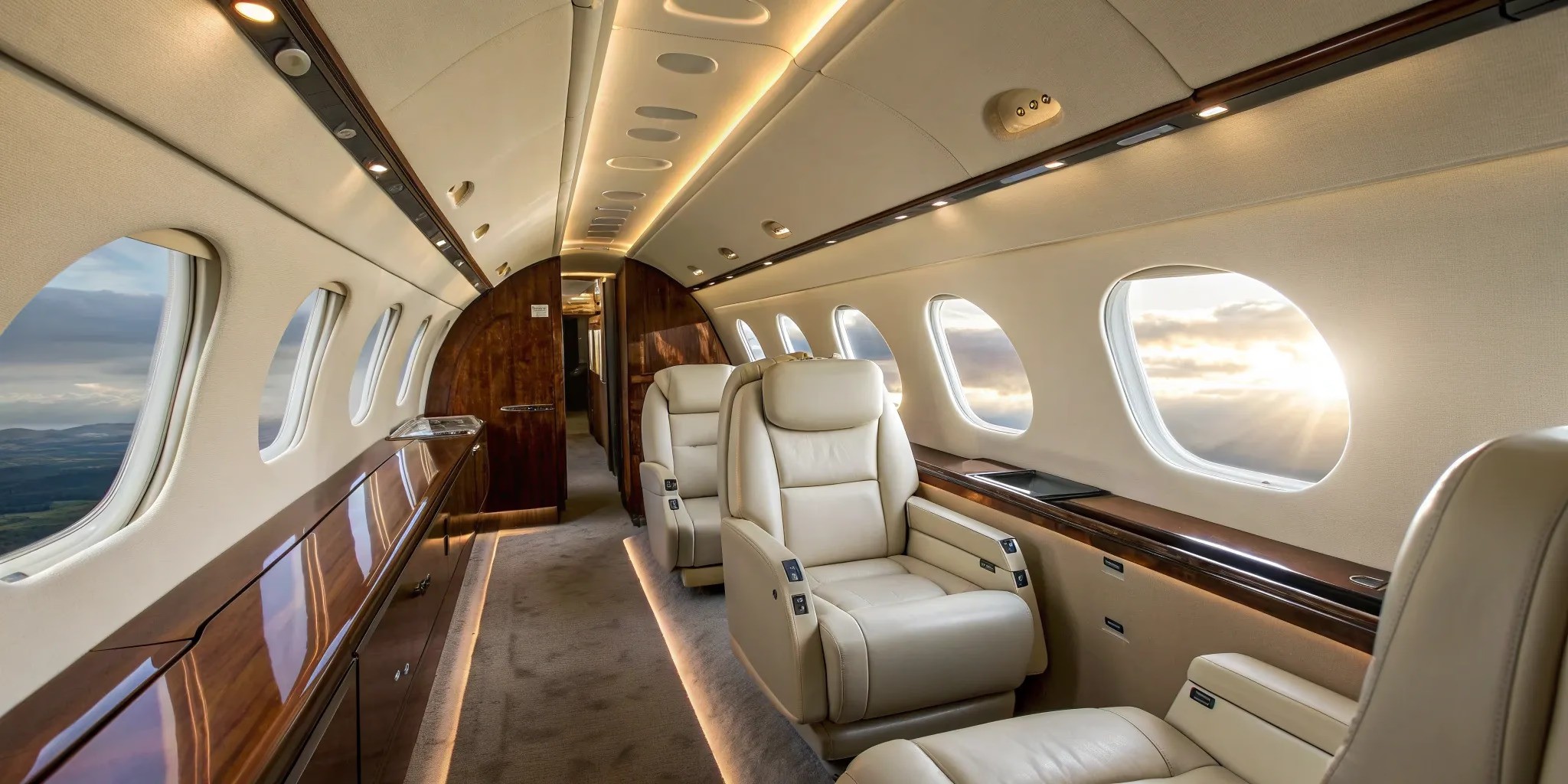
Can You Write Off a Private Jet Charter? A Business Tax Guide
Yes — in the right circumstances, chartering a private jet for business travel is a legitimate, fully deductible business expense. Here's the complete IRS framework, what qualifies, and how to document it.

This guide covers the complete picture: the IRS framework governing private jet deductions, what qualifies and what does not under the Tax Cuts and Jobs Act (TCJA), how to calculate the deductible portion of mixed-use flights, the documentation your accountant needs, and how charter compares to aircraft ownership from a tax standpoint. By the end, you will have a clear framework for what you can write off — and the right questions to bring to your CPA.
Tax Information Disclaimer
This article is for general informational purposes only and does not constitute tax, legal, or financial advice. Tax laws are complex and subject to change. Always consult a qualified CPA or tax attorney regarding your specific situation before claiming deductions.
Key Takeaways
Charter flights for legitimate business purposes are generally 100% deductible as ordinary and necessary business expenses under IRC Section 162.
The Tax Cuts and Jobs Act (TCJA) of 2017 eliminated most entertainment deductions — business travel deductions remain fully intact.
Mixed business/personal flights must be allocated: only the pro-rata business portion qualifies for deduction.
Detailed contemporaneous documentation is non-negotiable: date, route, passengers, business purpose, and amount paid must all be recorded.
In-flight meals follow the standard 50% meals deduction rule; entertainment on board is generally not deductible post-TCJA.
Charter has significant tax advantages over ownership: simpler treatment, no depreciation recapture, no SIFL imputed income complexity.
Is a Private Jet Charter Tax Deductible?
Under Internal Revenue Code Section 162, businesses can deduct expenses that are "ordinary and necessary" in carrying on a trade or business. Transportation costs, including private jet charter fees, fall squarely within this provision, provided the travel has a genuine, documented business purpose. This is not a grey area for straightforward business trips: an executive flying to close a deal, a CEO attending a board meeting in another city, or a sales team chartering a jet to visit a key client are all textbook examples of deductible business travel.
The confusion typically arises from conflating two distinct IRS categories: business travel and entertainment. Before 2018, both had a path to deductibility. The TCJA changed that permanently.
What the Tax Cuts and Jobs Act Changed
Before the TCJA took effect on January 1, 2018, businesses could deduct 50% of client entertainment expenses, which sometimes included charter flights used to entertain clients. The TCJA eliminated the entertainment deduction entirely under Section 274. Flying a client to a sporting event or taking prospects on a trip that is primarily recreational is no longer deductible.
What did not change: the deductibility of ordinary business travel. Flying charter to attend a business meeting, conference, client site visit, or any normal business activity remains fully deductible. The key distinction the IRS draws is between transportation to conduct business (deductible) and entertainment or leisure with a business flavour (not deductible post-TCJA).
Business Travel vs. Entertainment: The Critical Test
The cleanest test is to ask: would this trip have happened if the business purpose were removed?
If no — you flew specifically to conduct business. It is a deductible travel expense.
If yes — the trip would have happened regardless, and business discussion was incidental. It is entertainment. Not deductible.
If mixed — part business-driven, part personal. You must allocate and deduct only the qualifying portion.
The "Ordinary and Necessary" Standard
"Ordinary" means the expense is common and accepted in your type of business. "Necessary" means it is helpful and appropriate — not that it is indispensable. For businesses where executives regularly travel between cities, charter travel easily clears the ordinary standard. Courts and the IRS have consistently held that business travel by private charter is ordinary across a wide range of industries including finance, law, real estate, technology, entertainment, and professional services.
The "necessary" prong is where taxpayers sometimes face scrutiny. You do not need to prove that chartering was the only way to make the trip, only that it was appropriate given the business circumstances. Courts have upheld charter deductions where:
Tight scheduling required same-day travel between cities with poor commercial connections.
Confidential discussions made commercial travel impractical — M&A negotiations, sensitive client matters.
Multiple stops in a single day were only achievable via charter.
Time-sensitive deals required scheduling flexibility that commercial airlines could not provide.
Security or privacy considerations justified the additional cost of private aviation.
The practical takeaway: the stronger your business rationale and the more thoroughly you document it, the more defensible the deduction. A brief contemporaneous note explaining why charter was appropriate for the specific trip adds meaningful protection.
What Qualifies for a Deduction — And What Does Not
The table below covers the most common charter scenarios and their deductibility under current law:
Scenario | Deductible? | % Allowed | Key Condition |
|---|---|---|---|
Purely business flight — all passengers travelling for business | Yes | 100% | Document business purpose for every leg and passenger |
CEO/executive flies solo for client meetings | Yes | 100% | Log meeting details, names, business outcome |
Charter to attend business conference | Yes | 100% | Retain conference registration as supporting documentation |
Mixed flight — some seats used personally | Partial | Pro-rata share | Business seats ÷ total seats × cost |
Executive brings spouse (no business role) | Partial | Business share | Spouse's seat is personal; imputed income may apply for employees |
Client entertainment on charter flight (post-2017) | No | 0% | TCJA 2017 eliminated entertainment deductions (IRC §274) |
In-flight meals on a business flight | Partial | 50% | Standard 50% meals deduction rule applies |
Charter for medical emergency | Yes* | Schedule A | *Qualifies as medical expense, not business expense |
*Post-TCJA (effective Jan 1, 2018): entertainment deductions eliminated under IRC §274(a)(1). Consult your CPA for any partial exceptions. This table is informational only and does not constitute tax advice.
✓ Generally Fully Deductible
Flying to attend client meetings, board meetings, or business conferences
Executive travel between company offices, plants, or facilities
Multi-stop business trips completed in a single day by charter
Travel to close a deal, execute a contract, or conduct due diligence
Charter where commercial alternatives are impractical or insufficient
✕ Generally Not Deductible (Post-TCJA)
Entertainment flights — sporting events, concerts, leisure excursions with clients
Personal travel with no substantive business purpose
Purely recreational trips with incidental business conversation
Personal holidays — even if business emails were checked on board
~ Partial Deduction / Allocation Required
Mixed flights with both business passengers and personal guests
Business trip extended for personal leisure days
In-flight catering and meals (50% deduction applies)
Spouse or family members travelling alongside the executive with no business role
How to Calculate the Deductible Portion
100% Business Use
If every passenger on a charter flight is travelling for a business purpose and the trip itself is entirely business-driven, the full invoice amount is deductible. This is the most common scenario for straightforward executive travel and requires no allocation, only documentation.
Mixed Business and Personal Use: The Seat Allocation Method
When a flight carries a mix of business and personal travellers, the IRS requires you to allocate costs between the two. The most commonly accepted approach is the seat allocation method:
Determine the total number of occupied seats.
Identify the number of seats used for business purposes.
Calculate the business-use percentage: business seats ÷ total occupied seats.
Apply that percentage to the total charter cost to arrive at the deductible amount.
Example: A charter flight costs $20,000. Four passengers travel. Three are attending a business meeting; one is the executive's spouse with no business role. Business-use percentage = 3 ÷ 4 = 75%. Deductible amount = $15,000. The remaining $5,000 is a non-deductible personal expense and may trigger imputed income considerations.
Business Trips Extended for Personal Leisure
If you fly to a city for a three-day business conference and add two personal leisure days, the IRS requires allocation. The flight cost may be fully deductible if the primary purpose of the trip was business — i.e., the majority of days were business days. Hotel and expenses during the personal portion are not deductible. The IRS counts a "business day" as any day on which you spend more than half your working hours on business activities.
How to Document Private Jet Charter Deductions
Documentation is where otherwise valid deductions most commonly fail IRS scrutiny. The regulations under Section 274 impose strict substantiation requirements on all travel expenses. Records must be contemporaneous — created at or near the time of the flight, not reconstructed months later from memory. The IRS views after-the-fact documentation with significant scepticism in any audit context.
The complete documentation checklist for every charter flight you intend to deduct:
What to Record | Example / Note |
|---|---|
Date and time of departure | e.g. April 3, 2026 — departure 08:30 |
Departure and destination airports | e.g. Teterboro (TEB) → Miami Opa-Locka (OPF) |
Names and job titles of all passengers | e.g. John Smith (CEO), Sarah Lee (CFO), Mark Brown (client, ABC Corp) |
Business purpose of the trip | e.g. "Annual strategy review and client close meeting — ABC Corp" |
Business relationship of each passenger | Distinguish employees, clients, prospects, and personal guests clearly |
Amount paid — full charter invoice | Retain operator invoice with itemised costs including FBO and catering |
Documentation of business activity | Follow-up emails, signed contracts, meeting notes referencing the trip |
Personal-use portion identified (if any) | Note seat allocation; calculate personal portion for non-business travellers |
Meals served on board | If claiming, note in-flight meal cost — 50% rule applies |
Best Practice: The Flight Log
The most audit-resistant approach is to maintain a dedicated flight log — a simple spreadsheet or entry in your expense management system — completed at the time of each flight. Attach the operator invoice and supporting documentation (meeting invitations, conference registrations, client emails, signed contracts) to each entry. This takes under five minutes per flight and transforms a potentially contentious deduction into a clean, well-substantiated record.
TrueSkies provides fully itemised invoices for every charter, clearly breaking out the base flight cost, FBO fees, catering, and any additional charges. This level of transparency gives your accountant exactly what is needed to process the deduction without additional follow-up or reconciliation.
Which Businesses Can Deduct Private Jet Charter Costs?
The Section 162 deduction is available to any taxpaying business entity that engages in legitimate business travel. Entity type affects where the deduction appears on the return, not whether it is available:
C-Corporations and S-Corporations: Charter costs paid for business travel are deductible corporate expenses. S-Corp deductions flow to shareholders via Schedule K-1.
LLCs and Partnerships: Business travel deductions flow through to members or partners on Schedule K-1.
Sole Proprietors and Self-Employed Individuals: Deduct on Schedule C, subject to the same business-purpose and documentation requirements.
High-Net-Worth Investors: Travel to manage a substantial investment portfolio or visit portfolio companies may qualify as trade or business activity. Consult a tax attorney on whether your investment activity constitutes a "trade or business" under IRC standards.
Charter vs. Owning a Jet: Key Tax Differences
For businesses weighing charter against purchasing or fractional ownership of an aircraft, the tax treatment differs significantly. Charter is far simpler.
Charter: Clean and Straightforward
When you charter a private jet, you are purchasing a transportation service. The full invoice is treated as an ordinary business expense in the year paid. There is no depreciation schedule, no bonus depreciation recapture risk, no Section 280F limitations on "listed property" (which cap deductions on owned aircraft), and no complex SIFL imputed income calculations when employees fly for personal reasons. You deduct what you paid, in the year you paid it.
Aircraft Ownership: Further Complexity
Owning an aircraft introduces a range of tax complications entirely absent from charter:
Section 280F listed property rules: Limit depreciation deductions and impose strict business-use percentage tests. If business use falls below 50% in any year, deductions are recaptured.
Bonus depreciation and Section 179: Can accelerate first-year deductions but trigger recapture if business use drops below 50% in subsequent years.
SIFL imputed income: When an owned aircraft is used by employees for personal travel, the IRS requires the personal benefit to be calculated using the Standard Industry Fare Level formula and reported as W-2 income — an administratively intensive annual calculation.
Passive activity rules: May limit deductions for aircraft held in entities that are not classified as active businesses.
Depreciation recapture on sale: Gains on the sale of a depreciated aircraft may be taxed as ordinary income rather than capital gains under recapture rules.
Charter vs. Ownership: Tax Simplicity at a Glance
Charter: Deduct the invoice. Done. No depreciation, no recapture, no SIFL calculations.
Fractional ownership: Depreciation schedule + Section 280F limits + SIFL imputed income.
Full ownership: All of the above, plus passive activity rules and sale recapture risk.
For most business users: charter delivers the same access to private aviation with a fraction of the compliance overhead.
How TrueSkies Supports Tax-Compliant Business Travel
At TrueSkies Aviation Group, we understand that business travellers need more than a flight, they need documentation that stands up at tax time. Our invoicing is structured to give your accounting team everything required to support a clean deduction:
Fully itemised invoices: Base flight cost, FBO fees, catering, and additional charges listed separately. Your CPA sees exactly what was paid and for what purpose.
Transparent, all-in pricing: No post-flight surcharges that create reconciliation headaches. The quoted price is the invoiced price.
Operator-direct relationships: TrueSkies works directly with operators, not through chains of brokers. Cleaner documentation, fewer layers, one invoice per flight.
Pay-as-you-go model: No prepaid jet card balances sitting in holding accounts. Each flight is a discrete invoice, paid when flown — straightforward accounting treatment.
We also provide route confirmation documents and flight itineraries that serve as supporting documentation alongside your business purpose records. For regular business charter clients, our team is happy to coordinate with your travel manager or executive assistant to ensure documentation protocols are in place before travel, not scrambled together at year end.
Final Thoughts
Private jet charter and the business tax code can work together, provided you approach it correctly. The deduction is real, well-established, and defensible when the business purpose is genuine and the documentation is thorough. The TCJA did not close the door on private aviation deductions; it drew a clearer line between business travel (deductible) and entertainment (not).
The practical steps are not complicated: fly with a clear business purpose, document it contemporaneously, retain your invoices, and work with a CPA who understands travel and entertainment rules. The deduction is yours to take: approach it right, and it will hold up.
Related Articles
Frequently Asked Questions
Can I deduct 100% of a private jet charter for a business trip? Yes, if the flight is entirely for business purposes and all passengers are travelling for legitimate business reasons. You must document the business purpose for every leg and every passenger. If any portion of the flight or any passenger's travel is personal, you must allocate costs and can only deduct the business-use share. With clean documentation and a genuinely business-driven trip, 100% deductibility is standard.
Does the TCJA affect the deductibility of charter flights for business travel? The TCJA eliminated entertainment deductions effective January 1, 2018, but did not affect the deductibility of ordinary business travel under Section 162. Charter flights taken for legitimate business travel remain fully deductible. What changed: flights primarily for client entertainment or recreation with incidental business discussion are no longer deductible. Business travel — clearly defined, clearly documented — is fully intact.
What records do I need to deduct a charter flight? The IRS requires contemporaneous records establishing: (1) the amount paid, (2) the date and route of the flight, (3) the business purpose of the trip, and (4) the names and business relationships of all passengers. Retain the operator invoice, relevant business documentation such as meeting invitations, contracts, or conference registrations, and a brief note on the business purpose recorded at the time of travel. Reconstructed records created later from memory are viewed with scepticism in an audit.
Can an S-Corporation or LLC deduct a private jet charter? Yes. S-Corporations deduct business travel on Form 1120-S; the deduction flows to shareholders on Schedule K-1. LLCs treated as partnerships deduct on Form 1065 with pass-through treatment to members. The substantive rules are the same across entity types: the flight must be for a legitimate business purpose, and contemporaneous records must be maintained.
What happens if my charter flight carries both business and personal passengers? You must allocate the charter cost between business and personal use. The most commonly accepted method divides costs by the proportion of business seats to total occupied seats. For example, if three of four seats are used for business, 75% of the charter cost is deductible. The personal 25% is not deductible and may need to be addressed as imputed income if the personal traveller is an employee. Work with your CPA to ensure the allocation and any imputed income treatment is handled correctly.
Is a charter flight to a business conference fully deductible? Yes, provided the conference is directly related to your trade or business and you can document your attendance. Retain the conference registration confirmation and agenda. If you extend the trip for personal leisure, you must allocate: the transportation cost may still be fully deductible if the primary purpose of the trip was the conference, while personal-day accommodation and expenses are not deductible. The majority-of-days test governs whether the trip's primary purpose is deemed business.
Blog